
Every security vendor is now "agentic." Copilots, autonomous analysts and AI-driven remediation are on every roadmap and in every pitch. But there is a question that rarely gets asked: what are these agents actually reasoning over?
An AI agent is only as smart as the world model it works from. Give a large language model fragmented, siloed data, and it will produce fluent answers built on partial context. Give it a structured, connected model of the environment, and it can reason the way an experienced security team does.
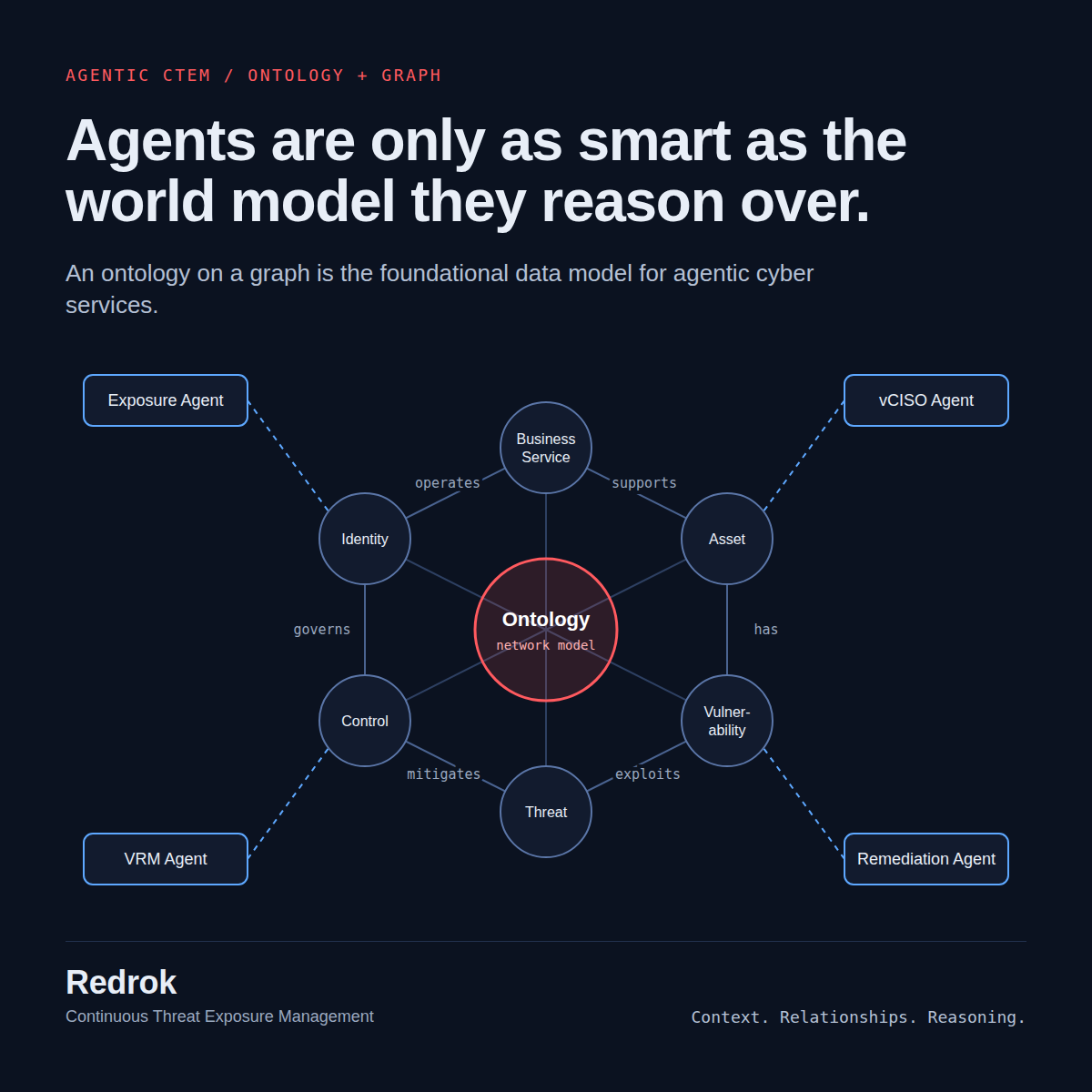
At Redrok, we believe the foundational data model for agentic cyber services is an ontology of the corporate network, stored in a graph database. This post explains why, how we build it, and why it is the platform every future agent will stand on.
The problem: security data lives in lists, risk lives in relationships
Most security stacks still store their knowledge as flat lists. Assets sit in a CMDB. Vulnerabilities sit in a scanner. Identities sit in the directory. Controls sit in a dozen tool consoles. Threat intelligence arrives as yet another feed.
Each list is useful on its own. None of them answers the questions that matter to a CISO:
Which identity can reach which critical asset?
Which vulnerability on that asset is actually exploitable from the outside?
Which control, if any, stands in the way?
Which business service goes down if the attacker succeeds?
These are questions about relationships, not records. Answering them requires joining the lists, understanding how entities connect, and following paths across them. Humans do this slowly and inconsistently, through spreadsheets and tribal knowledge. Agents working from the same lists cannot do it at all. They can summarize what each tool says, but they cannot reason about how an attack would actually unfold.
The answer: an ontology on a graph
An ontology is a formal definition of what exists in a domain and how those things relate. For cyber, it defines the entity types that make up an organization's attack surface, and the relationships between them.
A graph database is the natural home for that ontology. It stores entities as nodes and relationships as edges, so traversing "identity → has access to → asset → has → vulnerability → exploited by → threat" is a native query, not a fragile chain of joins.
The Redrok ontology captures:
Assets: endpoints, servers, cloud workloads, applications, domains and the external attack surface
Identities: users, service accounts, privileges and access paths
Vulnerabilities and misconfigurations, linked to the exact assets they affect
Threats: attacker techniques, exploit availability and exposure on the dark web
Controls: the security tools in place and what each one actually covers
Business context: the services, processes and data each asset supports
The real value sits in the edges: supports, has access to, exploits, mitigates, governs. Those relationships turn raw data into attack paths, blast radius and business impact. They are also what makes the model readable by agents: every fact has a type, every connection has a meaning, and every conclusion can be traced back node by node.
Step 1: Three agents collect the raw data
A model is only as good as what feeds it. Redrok populates the ontology through three collection agents, each responsible for a different view of the organization:
External agent. Maps the internet-facing attack surface the way an attacker would see it: domains, exposed services, certificates, cloud assets and the weaknesses visible from outside.
Internal agent. Maps what lives inside the network: assets, identities, vulnerabilities, misconfigurations and the security controls deployed on each.
Dark Web agent. Watches the places attackers talk and trade: leaked credentials, mentions of the organization, and threat intelligence relevant to its industry and technology stack.
Each agent writes into the same ontology. A leaked credential found on the dark web is not a standalone alert; it becomes an edge to a real identity, which connects to the assets that identity can reach. An exposed service found externally links to the internal asset behind it. Collection is not about volume. It is about placing every fact in context from the moment it arrives.
Step 2: The Red agent builds the attack graph
Raw data, even connected data, is still a description of the environment. The next step is to think like an attacker.
The Red agent reasons over the combined model and builds the attack graph. It asks the questions an adversary would ask: where can I get in, what can I reach from there, and how do I get to what matters? It then answers them using the facts in the ontology:
Which exposures chain together. A low-severity misconfiguration and a leaked credential may be harmless alone and critical in combination.
Which paths lead to critical assets. Not every vulnerability sits on a path to the crown jewels; the ones that do deserve attention first.
Which controls actually break the path. A control that covers the asset but not the technique does not reduce risk.
Which business services are at risk. Every path ends in business impact, expressed in terms executives understand.
The result is a shift from alert lists to attack paths, and from CVSS scores to prioritization by real exploitability and business impact. Because every step in a path is a node and an edge in the graph, every finding is explainable: the Red agent can show exactly why it reached its conclusion.
Step 3: The complete model becomes the foundation
Once the collection agents have populated the ontology and the Red agent has overlaid the attack graph, Redrok holds something far more valuable than a set of findings: a living model of the organization that combines raw data, attack paths and business context.
That model is the foundation for every agent that follows. Instead of each new capability building its own data pipeline and its own partial view, it plugs into the same shared truth:
Remediation agent uses the attack graph to choose the fixes that break the most critical paths with the least effort.
vCISO agent translates the model into posture, priorities and board-level reporting.
Vendor risk (VRM) agent brings third parties into the graph as first-class nodes, with their exposures and their connections into the network.
Security awareness agent targets training to the identities that sit on real attack paths, not to everyone equally.
The same principle opens Redrok to an ecosystem of partner agents. Each agent declares which parts of the model it needs, works from the same context, and writes its results back. Every agent added makes the model richer, and a richer model makes every agent smarter.
Over time, the model also becomes the system's memory. It records what agents decided and why, so every action is auditable, and it enables new questions: not only "what is exposed today," but "what happens if we change this," and "where will the next attack path appear."
What this means for security leaders
When evaluating agentic security platforms, the most important question is not which large language model they use. Models improve and commoditize quickly. The lasting differentiator is the data model the agents reason over. Three questions separate real agentic platforms from chatbots layered on dashboards:
Does the platform model relationships, or only records? Without relationships there are no attack paths, only lists.
Can every agent conclusion be traced back to facts? Explainability is what lets security teams trust and act on agent output.
Do new agents share one model, or bring their own data silos? A shared foundation is what lets capabilities compound instead of fragment.
At Redrok, our answer to all three is the ontology. LLMs bring the reasoning. The ontology brings the truth. Without a shared, structured model of the environment, agents guess at context. With it, they act like a security team that knows every corner of the network.
The future of cyber is agentic. Its foundation is the graph.
To see how Redrok builds the attack graph for your organization, contact our team.